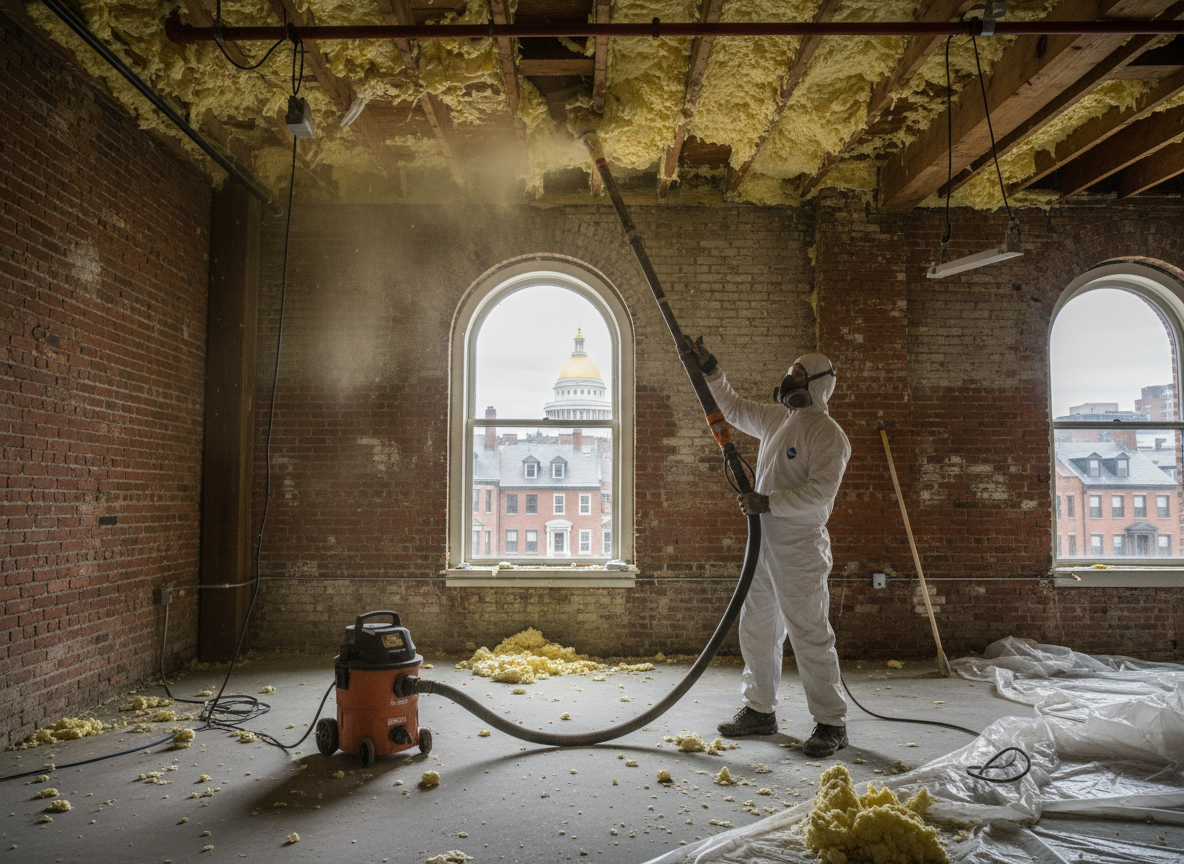
Commercial properties in Boston often feature solid brick walls and pitched roofs dating back to the Victorian era around the market square and along South Street. Spray foam installed in these structures frequently traps moisture against the masonry because the original lime mortar cannot breathe. Removal requires careful mechanical scraping and vacuum extraction to avoid damaging historic brickwork while preventing dust from settling into adjacent retail units or offices.
Lincolnshire's frequent rainfall and high humidity mean any remaining foam residue quickly leads to mould growth on timber joists. Technicians working on commercial jobs must isolate HVAC systems first, then use negative air machines to contain particles. Edge cases include foam that has bonded to asbestos-containing ceiling tiles common in 1960s warehouses near the river, requiring licensed abatement coordination before foam extraction can begin.
Access limitations in narrow alleyways behind shops on Wide Bargate or in multi-storey buildings on Main Ridge demand sectional scaffolding rather than full platforms. Disposal follows Environment Agency rules for polyurethane waste, with loads taken to licensed sites rather than general landfill. Owners notice improved ventilation and lower heating costs once the foam is gone and proper insulation replacements are fitted.
Technician insight
In Boston, the thing that catches most people out with Commercial Spray Foam Removal is the solid brick terraces around the market square where foam was pumped straight into unventilated roof voids; our frequent winter rain then drives moisture straight through the lime mortar and into the new plaster ceilings below.
Warehouse Unit Near the Haven
A commercial unit off London Road had closed-cell foam sprayed across the underside of a corrugated roof ten years earlier. Condensation dripped onto stock during heavy autumn rain. We isolated the space, removed the foam in sections, installed temporary ventilation and left the owner with a dry, code-compliant roof ready for new insulation.
How it works
- 1
Site Survey and Risk Assessment
Technicians inspect the commercial space, identify foam locations, check for hidden services and note any asbestos or lead risks common in Boston's older stock.
- 2
Containment and Isolation
Work areas are sealed, HVAC systems isolated and negative pressure established to prevent dust migration into trading floors or offices.
- 3
Foam Extraction
Mechanical removal combined with HEPA vacuuming clears foam from cavities, rafters and wall voids without damaging original brick or timber.
- 4
Clearance and Disposal
All waste is bagged, labelled and removed to licensed facilities; final air quality checks confirm the space is safe for reoccupation.
Pricing
Upfront quotes based on access, building age and volume of foam; 24/7 availability for urgent commercial call-outs.