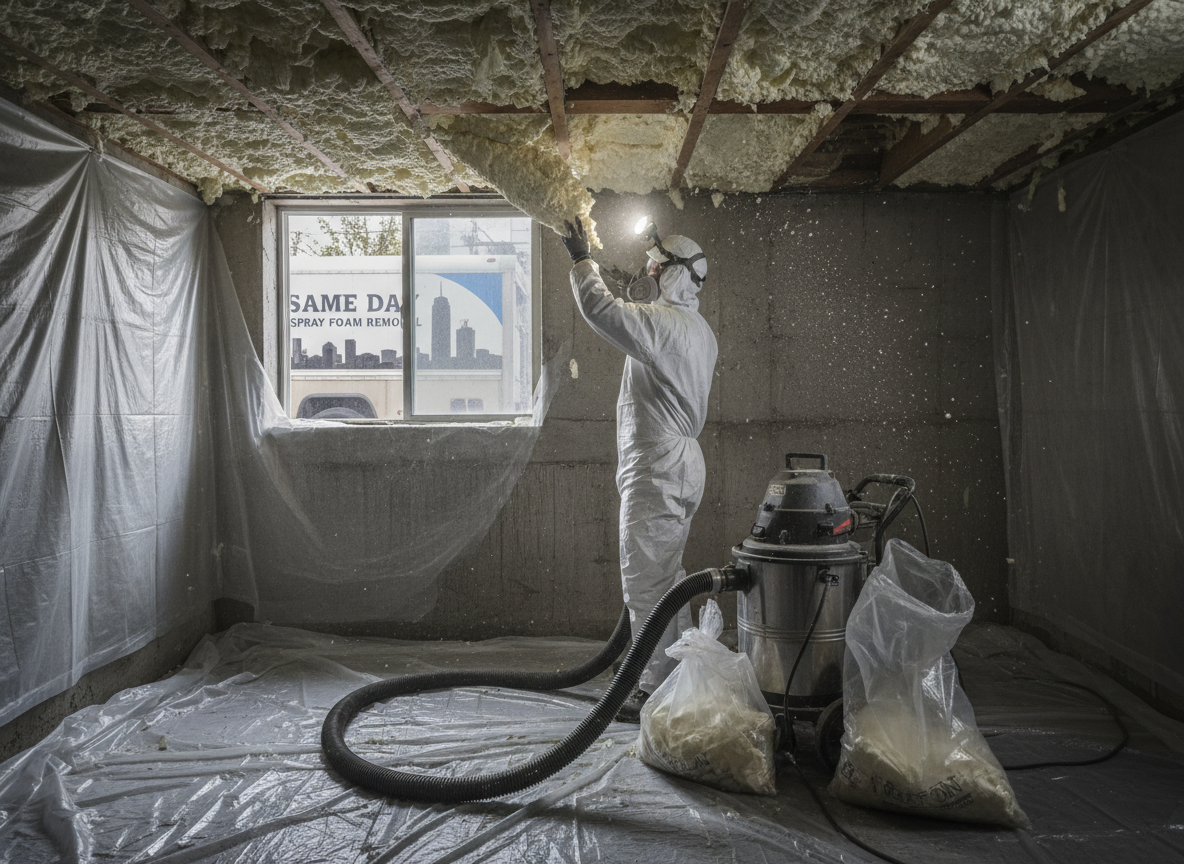
Boston Lincolnshire properties often date from the Victorian era through to the 1970s, with solid brick walls and timber roof voids that trap spray foam against lime mortar. Once winter temperatures drop and the flat fenland landscape holds moisture, the foam blocks ventilation and forces condensation into joists and plaster. Same day removal starts with negative-pressure extraction to pull material outward without spreading dust through the rest of the house, followed by hand scraping of residue from rafters and brickwork.
Edge cases appear regularly in terraced rows near the River Witham where foam was injected into cavity walls that have since flooded. Removing it requires cutting inspection hatches, vacuuming loose fill, and checking for hidden timber decay before the voids can be left open to dry. Lincolnshire Building Regulations now flag closed-cell foam in unventilated spaces, so we document every void opened and advise on breathable alternatives that suit the local climate.
Homeowners sometimes attempt DIY steam cleaning which softens the foam but leaves a sticky film that re-adheres to new insulation. We use solvent-free mechanical methods and HEPA filtration to keep the job contained within the work area, finishing with a moisture meter check on every exposed surface before handing the property back the same evening.
Technician insight
In Boston the thing that catches most people out with same day spray foam removal is the solid brick terraces around the market square where foam was pumped into walls sitting on damp fenland soil. The foam seals in rising moisture that then rots the floor joists, so we always lift a few boards before we finish.
Loft Foam Removal in a South Street Terrace
Foam in a 1930s loft had caused black mould on the rafters after recent heavy rain. We isolated the void, extracted the material under negative pressure, scraped residue from the timbers, and confirmed moisture levels had dropped enough for the owners to ventilate and re-insulate safely the same evening.
How it works
- 1
Site Assessment
We arrive within hours, inspect all treated voids from the loft down through walls, and identify any water ingress points common in Boston's older housing.
- 2
Containment Setup
Dust barriers and negative air machines isolate the work zone so removal does not affect living spaces in terraced or semi-detached homes.
- 3
Mechanical Extraction
Foam is cut and vacuumed in sections, with residue scraped from rafters, brick and plaster to leave surfaces ready for inspection.
- 4
Final Drying Check
Moisture readings confirm the structure can breathe again before we clear the site the same day.
Pricing
Upfront quote after inspection, based on access and volume of foam.