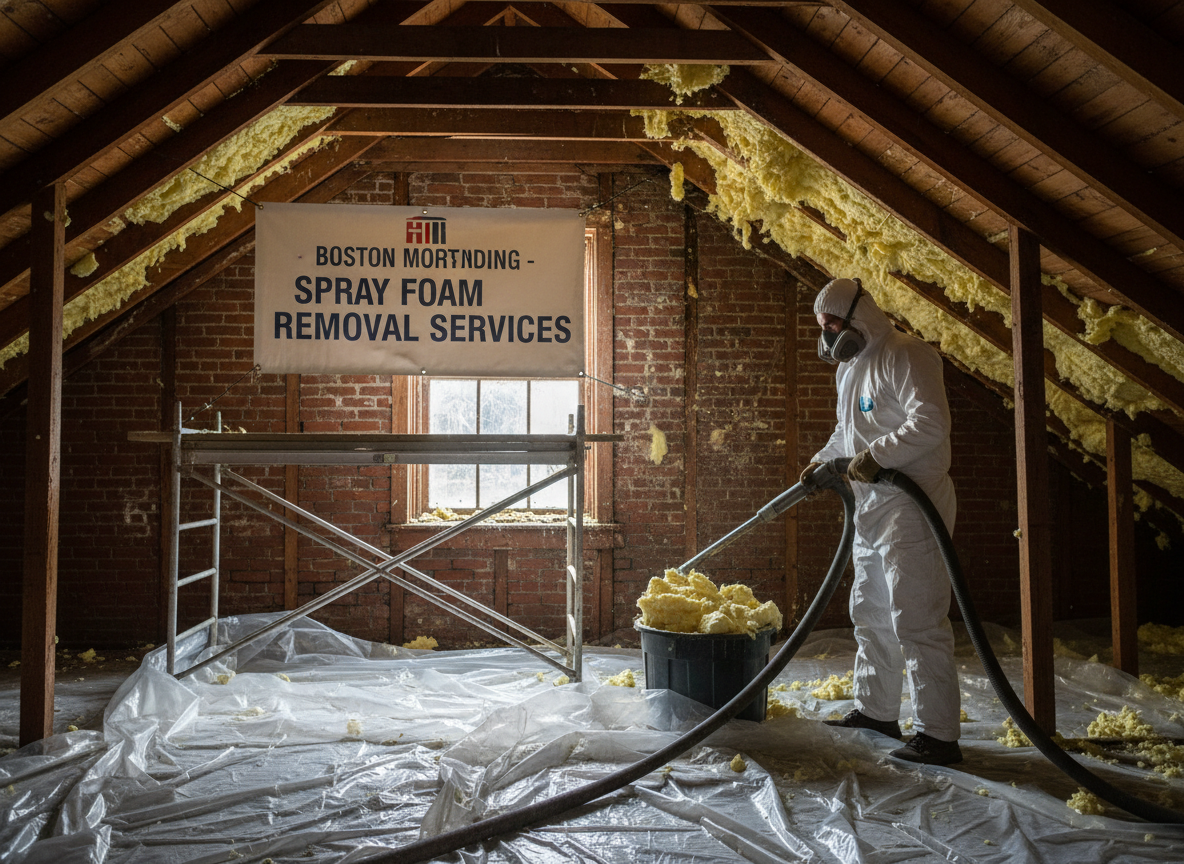
Mortgage lenders frequently flag spray foam insulation in Boston roofs because it can trap moisture against timber in the area's older terraced and semi-detached stock. Properties around South Street and Skirbeck often feature Victorian or Edwardian rafters where closed-cell foam was sprayed directly onto boards, restricting ventilation and accelerating decay during Lincolnshire's frequent wet winters. Removal requires sequential cutting and peeling to avoid damaging original laths, followed by moisture checks on exposed timber before any new ventilation or insulation can be considered.
In Boston the job changes with access constraints common to narrow ginnels and shared roof voids. Homeowners near the River Witham face additional care around potential water ingress paths that foam previously masked. Technicians must document every stage with photographs and moisture readings so the lender receives clear evidence that the roof structure is now visible and dry. Rushing the peel-back risks leaving residue that still blocks approval.
Edge cases include foam applied over electrical cables or in eaves that run into neighbouring properties. These demand hand tools rather than mechanical stripping to prevent damage claims. Once cleared, the void is left open for inspection, and temporary breathable membrane is fitted only where the lender specifies. This measured approach prevents callbacks when surveyors revisit after works.
Homeowners in Boston PE21 often discover the foam was added during a previous loft conversion without building control sign-off. Removal restores the ability to demonstrate compliance, but only if all residue and fixings are extracted cleanly. Leaving even small patches can trigger a second rejection.
Technician insight
In Boston the thing that catches most people out with mortgage lender spray foam removal is the hidden rot along the eaves in pre-1910 terraces where the foam was sprayed right into the gutter line; once you start peeling you often find the original timber has been sitting wet for years because the foam blocked the only airflow path the Witham valley weather could provide.
Lender Block Lifted in Skirbeck
A Boston terraced house failed its mortgage valuation due to full loft foam coverage. Inspection revealed damp rafters along the party wall. Careful sectional removal exposed the extent of wetting without further damage. Cleared void and moisture data allowed the lender to proceed with the loan.
How it works
- 1
Initial Assessment
Visit the Boston property to map foam coverage, check rafter condition and note any lender-specific requirements.
- 2
Site Preparation
Protect floors and electrics, then create sealed extraction zones to contain dust within the roof void.
- 3
Foam Extraction
Cut and peel foam in sections, inspecting timber for rot as work progresses across the Boston roof space.
- 4
Documentation And Handover
Photograph cleared areas with moisture readings and supply the report pack for the mortgage lender.
Pricing
Upfront quotes issued after inspection; cost driven by roof size, foam depth and access difficulty in Boston properties.